ADA Restroom Signs for Ohio Businesses
ADA restroom signs are the signs most often cited on an Ohio building inspection, and the most often bought wrong. A sign that looks correct can still fail: the characters not raised, the Braille the wrong grade or spacing, the pictogram field too short, the finish too glossy, or the sign mounted on the door instead of on the latch-side wall.
Zealot Signs fabricates ADA restroom signs in our own shop at 71 Seldom Seen Rd in Powell and installs them across Ohio. We build to the 2010 ADA Standards for Accessible Design as adopted through the Ohio Building Code, and we install at the heights and locations an inspector measures.
How Zealot Signs delivers this work
Every step below happens inside Zealot Signs — no brokered design, no subcontracted fabrication, no day-rate install crew.
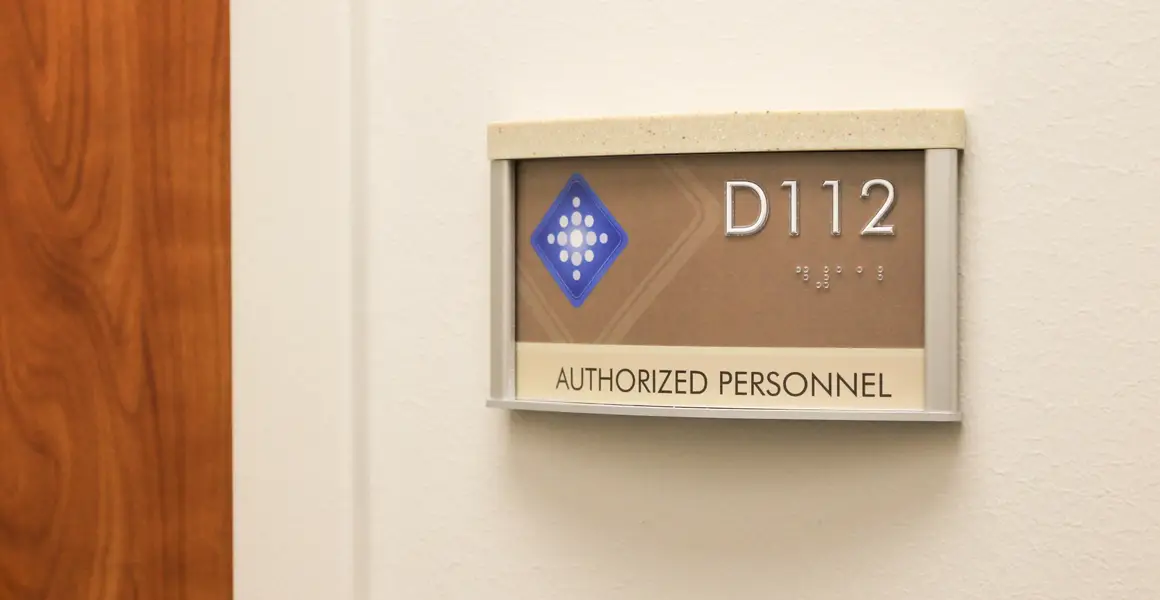
What makes a restroom sign ADA compliant
- Tactile characters raised 1/32 inch minimum, in a sans serif, non-italic, uppercase face — not engraved or printed copy.
- Grade 2 Braille below the text, with rounded or domed dots and the required spacing from the tactile characters.
- Character height within the permitted range for a tactile sign, which is smaller than most people expect.
- Non-glare finish with at least a 70 percent light-reflectance contrast between the characters and their background.
- Geometric pictograms where the jurisdiction requires them: a circle for a women's room, a triangle for a men's room, a triangle on a circle for unisex, with any pictogram in its own field above the tactile copy.
- The International Symbol of Accessibility where the restroom is accessible and the building has non-accessible restrooms.
Mounting: the requirement that gets missed
Tactile restroom signs belong on the wall adjacent to the latch side of the door, not on the door itself, so a person can find the sign without standing in the door's swing. Where there is no wall space on the latch side, the sign moves to the nearest adjacent wall.
Mounting height is measured from the finished floor to the baseline of the lowest tactile character and to the top of the highest, and there must be a clear floor approach where a person can stand within reach of the sign while the door is closed. We install to those measurements and photograph the completed installation for your records.
All-gender, family, and single-occupancy restrooms
Signage for single-occupancy and all-gender restrooms is where Ohio buildings vary most. Some jurisdictions still require the geometric pictogram set; others accept a text-and-Braille sign reading Restroom or All Gender Restroom with the accessibility symbol. Family and companion-care rooms often need their own identification plus wayfinding pointing to them.
We confirm what your local building department expects before production. That conversation costs nothing and is far cheaper than replacing a full building's restroom signage after a punch-list walk.
Materials and finishes for Ohio commercial interiors
- Photopolymer signs with integrally raised characters and Braille — the standard durable choice for schools, medical offices, and public buildings.
- Acrylic subsurface-printed panels with applied tactile characters, for a cleaner architectural look in office and hospitality lobbies.
- Brushed aluminum, stainless, and bronze-look faces where the restroom signage has to match a metal lobby package.
- Insert-style holders where a tenant name or room designation changes, with the tactile and Braille portion staying permanent.
- Matte and satin finishes only — high-gloss faces fail the non-glare requirement.
Restroom signs as part of a full ADA package
Restrooms are rarely the only tactile signage a building needs. Exit and stairwell identification, room and suite numbers, area of refuge signage, elevator jamb plates, and permanent room names all fall under the same rules, and an inspector who finds one wrong will look at the rest.
We survey the floor plan, produce a message schedule listing every sign, its copy, its Braille, and its mounting location, and fabricate the whole package at once so the finishes match and the count is right. This is the same package we build for medical offices, schools, and multifamily communities.
ADA restroom signs: common questions
What are the ADA requirements for restroom signs?
A restroom sign must have raised tactile characters in uppercase sans serif, Grade 2 Braille beneath them, a non-glare finish with high contrast, and any pictogram in a separate field above the tactile copy. It must be mounted on the wall on the latch side of the door at the height range set by the 2010 ADA Standards, with a clear floor approach.
Does an ADA restroom sign go on the door or the wall?
On the wall, adjacent to the latch side of the door. Mounting a tactile sign on the door means a person reading it can be struck when the door opens, which is why the standard places it on the wall. If there is no latch-side wall space, it moves to the closest adjacent wall.
Do single-occupancy restrooms in Ohio need ADA signs?
Yes. Any permanent room identification, including a single-occupancy or all-gender restroom, needs tactile characters and Braille. Whether the geometric pictogram is also required depends on your local building department's interpretation, which we confirm before we produce the signs.
How much do ADA restroom signs cost?
Individual restroom signs are among the least expensive signs we make, and cost per sign drops when they are ordered as part of a building package rather than one at a time. Material choice drives the difference — photopolymer is economical and durable, while metal-faced architectural signs cost more.
Can you replace non-compliant restroom signs on an existing building?
Yes, and it is common work for us — usually after a code review, an occupancy inspection, or a complaint. We survey what is installed, list what fails and why, and replace only what needs replacing rather than rebidding the whole building.
Related pages
More Zealot Signs products & services
Monument signs for apartment complexes (Columbus)
Entrance monuments and property identification for Columbus apartment communities — masonry, aluminum cabinets, illuminated or not.
Channel letter & commercial sign repair (Columbus)
Dark letters, flickering LEDs, dead power supplies, water intrusion — diagnosed and repaired by our own crews across Columbus.
Commercial signage in Columbus, Ohio
A licensed commercial sign company for Columbus storefronts, restaurants and office properties — every step in-house.