Blade Signs & Projecting Signs in Central Ohio
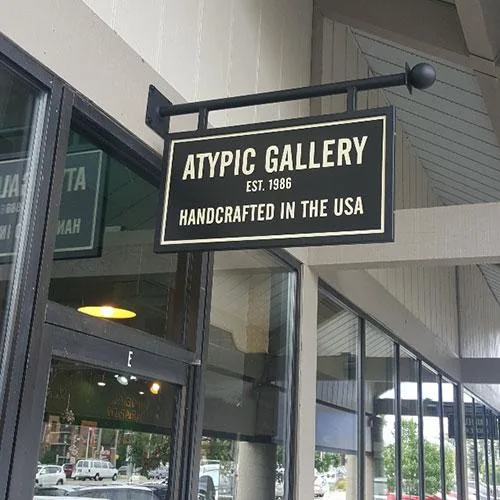
Blade signs are how a business gets seen on a sidewalk. On a walkable Ohio street — the Short North, Old Worthington, Grandview Yard, Historic Dublin, downtown Delaware, Olde Pickerington Village — a flat wall sign disappears the moment someone is standing under it. A blade sign projects out perpendicular to the building so it reads down the block in both directions, at the height a person actually looks.
Zealot Signs fabricates and installs blade signs and projecting signs from our shop at 71 Seldom Seen Rd in Powell. We handle the design, the mounting bracket and its attachment to the building, the electrical if the sign is lit, and the permit with whichever Ohio jurisdiction reviews the parcel.
How Zealot Signs delivers this work
Every step below happens inside Zealot Signs — no brokered design, no subcontracted fabrication, no day-rate install crew.
Blade sign types we build
- Painted or powder-coated aluminum panels with dimensional or routed copy — the workhorse for retail and restaurant storefronts.
- Double-sided illuminated cabinets with push-through or routed and backed acrylic copy, lit internally with LED for even faces.
- Halo-lit and edge-lit blades that throw light onto the building rather than out at the street, common where a district limits internal illumination.
- Carved and painted wood or HDU panels with gold leaf accents, used in historic districts where a plastic-faced cabinet will not be approved.
- Shaped and cut-out blades where the sign outline follows the logo instead of sitting in a rectangle.
- Decorative scroll and bracket assemblies, fabricated to match the building's era rather than pulled from a catalog.
Ohio blade sign codes: projection, clearance, and sign area
Almost every Ohio jurisdiction regulates blade signs on three numbers: how far the sign may project from the wall, how much clearance there must be above the sidewalk, and how many square feet the sign face may be. The specifics differ by city, by zoning district, and often by whether the sign hangs over a public right-of-way.
The City of Columbus reviews projecting signs under its graphics code and issues a Graphics Permit; a sign that overhangs a public sidewalk generally also needs the right-of-way encroachment addressed. Worthington and Upper Arlington add architectural review, where materials, bracket style, and illumination method all get looked at, not just dimensions. Dublin reviews signage in Historic Dublin against its own district standards. Grandview Heights, Delaware, Canal Winchester, and Pickerington each run their own storefront review.
We confirm the governing limits for your address before we draw anything, because designing a blade sign to a number that does not apply to your parcel is how projects lose a month.
Mounting a blade sign without damaging the building
The bracket is the part that fails. On the older brick common in Ohio downtowns, anchors have to land in solid masonry rather than in mortar joints or in soft, deteriorated face brick, and the load has to be spread across enough fasteners that the sign does not work itself loose in a winter of freeze-thaw cycles and wind.
Storefronts with canopies, transom glazing, cast-iron columns, or EIFS need a different approach — through-bolting, structural backing, or a mounting point moved to a member that can actually carry the sign. Our installers survey the wall first and detail the attachment on the shop drawings, and where the building is a designated historic structure we keep penetrations to the minimum a reviewer will accept.
Sizing and lighting for a sidewalk, not a highway
A blade sign is read from twenty to eighty feet away, usually at an angle, often by someone walking. That argues for fewer words, heavier letterforms, and strong contrast — a name and maybe a category, not a service list. We mock the sign up against a photo of your storefront at the real projection so you can see what it looks like from up the block.
For illumination, an internally lit cabinet reads best at night on a busy corridor, while halo-lit copy or a gooseneck-lit painted panel suits a historic street and is frequently what review boards prefer. Both use LED modules and UL-listed power supplies.
Blade signs as part of a storefront package
Most of the blade signs we build go up alongside other signage: a set of channel letters or dimensional lettering on the fascia, window graphics with hours and services, a door decal, and interior signage. Producing them together keeps the finishes, letterforms, and paint colors matched — and it means one permit submittal and one install day rather than three.
Blade signs: common questions
What is a blade sign?
A blade sign is a sign mounted perpendicular to a building wall so it projects out over the sidewalk and can be read from both directions along the street. It is also called a projecting sign, a hanging sign, or a bracket sign. Blade signs are the standard for walkable retail districts because a flat wall sign is invisible to pedestrians standing beneath it.
Do I need a permit for a blade sign in Ohio?
Almost always yes. Ohio municipalities review blade signs for projection distance, sidewalk clearance, and sign area, and an illuminated blade sign typically needs an electrical permit as well. A sign overhanging a public sidewalk may also require right-of-way approval. Zealot Signs researches the requirements for your address, prepares the drawings, and files the application.
How much does a blade sign cost?
Cost depends on size, whether it is illuminated, the bracket and finish, and how difficult the mounting is. A modest painted double-sided panel on a standard bracket is one of the least expensive permanent exterior signs a business can buy; an illuminated double-sided cabinet with a custom fabricated bracket costs considerably more. We quote from your actual storefront rather than a price list.
How high does a blade sign have to hang?
Codes set a minimum clearance above the walking surface — commonly around eight feet, though the governing number varies by jurisdiction and by whether the sign is over private property or a public sidewalk. We verify the requirement for your parcel before design so the bracket height is right the first time.
Can a blade sign go on a historic building?
Yes, and blade signs are often the preferred option in Ohio historic districts because they suit the scale of the buildings. Review boards typically want traditional materials, external or halo illumination rather than a bright plastic face, and a bracket that fits the architecture. We build to those standards and produce the submittal set the board expects.
Related pages
More Zealot Signs products & services
Monument signs for apartment complexes (Columbus)
Entrance monuments and property identification for Columbus apartment communities — masonry, aluminum cabinets, illuminated or not.
Channel letter & commercial sign repair (Columbus)
Dark letters, flickering LEDs, dead power supplies, water intrusion — diagnosed and repaired by our own crews across Columbus.
Commercial signage in Columbus, Ohio
A licensed commercial sign company for Columbus storefronts, restaurants and office properties — every step in-house.